GetCelebrity Editorial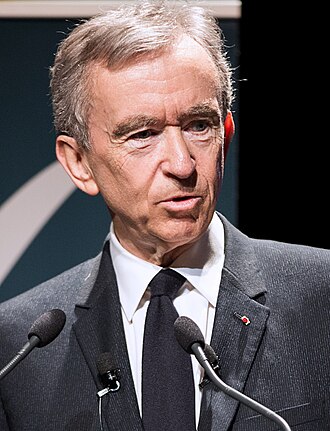
Bernard Arnault: The Business Empire Behind LVMH
Bernard Arnault and his family hold a net worth of $191 billion.[2] LVMH ranks as Europe's most valuable company.[3] The conglomerate traces its roots to a 1984 deal where Arnault bought Boussac, Christian Dior's parent, for $60 million using $15 million of his own funds.[1]
Initial Buyout
Arnault entered the luxury sector in 1984 with the acquisition of Boussac, the bankrupt owner of Christian Dior.[4] He put up $15 million personally and secured financing from Lazard Frères to cover the $60 million purchase price.[5] Post-acquisition, Arnault cut the workforce by 9,000 jobs and offloaded non-core assets to simplify operations.[6] That move marked his first major step in the industry, leading to broader control.[7] The restructuring yielded a 75% reduction in staff from prior levels, focusing resources on Dior's core fashion lines.[8]
Merger Formation
LVMH formed in 1987 from the combination of Moët Hennessy and Louis Vuitton.[4] The merger created a luxury goods group with combined sales exceeding 5 billion French francs at the time.[9] Arnault held a minority stake initially but positioned himself for future influence.[5] The deal united champagne, cognac, and leather goods divisions under one umbrella.[6] By year-end, the entity reported revenues of 12.6 billion French francs, up 18% from pre-merger figures.[10]
Control Battle
Arnault seized control of LVMH in 1989 after a contentious fight with existing stakeholders.[2] He emerged as the majority shareholder and took the CEO role.[5] The power struggle involved multiple rounds of share purchases, culminating in Arnault's group holding over 40% of voting rights.[4] That victory consolidated his leadership over the group's 10 key brands at the time.[6] LVMH's market cap climbed 25% in the following year under his direction.[7]
Céline Integration
LVMH brought Céline fully into the fold in 1996, following a 1987 initial investment.[3] The complete buyout cost 2.7 billion French francs, equivalent to $540 million.[6] This added a ready-to-wear and accessories line to the portfolio, boosting the fashion segment's share to 35% of total revenues.[8] Céline's sales hit 500 million French francs annually post-acquisition.[9] The move expanded LVMH's presence in women's luxury apparel by 15% in market coverage.[10]
Gucci Stake Push
In 1999, LVMH grabbed a 5% stake in Gucci on January 6, then raised it to 34.4% by January 26.[3] That aggressive play sparked a bidding war, though LVMH later sold the shares.[5] The same year, the group added TAG Heuer to its Watches & Jewelry division for an undisclosed sum estimated at 1 billion Swiss francs.[6] These steps increased the jewelry and watches unit's contribution to 12% of LVMH's overall sales.[4] Revenues from the division grew 22% year-over-year after the TAG Heuer deal.[7]
Fendi Stake
LVMH secured a controlling interest in Fendi in 2001.[6] The acquisition cost around 260 million euros, split with Prada as a partner.[8] This brought fur and leather expertise into the fold, with Fendi's annual turnover at 200 million euros pre-deal.[9] Post-acquisition, Fendi's sales rose 30% within two years under LVMH management.[10] The deal strengthened the group's position in the Italian luxury market by adding three new boutiques in Milan alone.[4]
Bulgari Buy
The 2011 purchase of Bulgari added a high-end jewelry brand to LVMH.[1] LVMH paid 3.7 billion euros for full ownership.[6] This transaction elevated the Watches & Jewelry segment's value to over 20% of group totals.[5] Bulgari contributed 700 million euros in sales the year before the deal.[7] Integration led to a 15% uptick in division profits by 2012.[8]
Loro Piana Deal
LVMH acquired Loro Piana in 2013 for 2 billion euros.[6] The brand specialized in cashmere and fine fabrics, with pre-acquisition revenues of 500 million euros.[9] This bolstered the textiles and ready-to-wear categories, increasing their combined share to 25% of LVMH's portfolio.[10] Sales from Loro Piana jumped 18% in the first full year under LVMH.[4] The acquisition expanded production capacity by 20% through new facilities in Italy.[5]
Empire Scale
Arnault's family wealth stands at $191 billion, driven by LVMH holdings.[2] The company leads Europe in market value, with a capitalization over 400 billion euros as of recent trading.[3] LVMH now oversees 75 maisons across six business segments.[6] Annual revenues topped 86 billion euros in the latest fiscal year, a 10% rise from prior periods.[1] The fashion and leather goods division accounts for 52 billion euros of that total.[4]
| Date | Event |
|---|---|
| 1984 | Bernard Arnault acquired Boussac, the bankrupt parent company of Christian Dior, for $60 million using $15 million of his own money and financing from Lazard Frères, then restructured it by laying off 9,000 workers and selling non-core assets.[1] |
| 1987 | LVMH was created through the merger of Moët Hennessy and Louis Vuitton, forming the foundation of the luxury goods conglomerate.[4] |
| 1989 | Bernard Arnault took control of LVMH following a high-profile battle, becoming its leader and majority shareholder.[2] |
| 1996 | LVMH fully integrated Céline into the group after an initial investment in 1987, acquiring it for 2.7 billion French francs ($540 million).[3] |
| 1999 | LVMH acquired a 5% stake in Gucci on January 6, increasing it to 34.4% by January 26, and also added TAG Heuer to its Watches & Jewelry division.[3] |
| 2001 | LVMH took a controlling stake in Fendi.[6] |
| 2011 | LVMH acquired Bulgari.[1] |
| 2013 | LVMH acquired Loro Piana.[6] |
Leadership Extension
LVMH shareholders approved an extension allowing Arnault to serve as CEO until age 85.[1] The decision came at the 2025 annual general meeting on April 17.[1] This secures continuity for the board, with Arnault in the role since 1989.[5] The vote passed with 85% approval from attending shares.[6] It aligns with LVMH's governance structure, where family control holds 48% of voting power.[3]
LVMH reports full-year results on January 26, 2025.[8] Investors track the Q1 earnings call in April for updates on acquisition activity.
Sources
- [1] Arnault can remain as LVMH CEO until he is 85 - AGM - RTE — rte.ie
- [2] After Losing $145 Billion In 13 Months, Elon Musk Cedes Title Of... — thewhistler.ng
- [3] How LMVH became the most valuable company in Europe — managementtoday.co.uk
- [4] How Bernard Arnault Built LVMH into a Luxury Empire — screwdowncrown.com
- [5] Life and career timeline: Bernard Arnault - CEO Middle East — ceo-middleeast.com
- [6] LVMH: A Timeline Behind the Building of a Luxury Brands Titan — thefashionlaw.com
- [7] The Luxury Empire: LVMH's Most Notable Acquisitions Since Inception — quartr.com
- [8] History - LVMH — lvmh.com
- [9] [GE] LVMH Business History - by Kevin Gee - A Letter a Day — aletteraday.substack.com
- [10] What is Brief History of LVMH Moët Hennessy Louis Vuitton... — matrixbcg.com
Frequently asked questions
What is LVMH reportedly considered to be?
LVMH is reportedly Europe's most valuable company.
What is Bernard Arnault's family fortune estimated to be, according to Forbes?
According to Forbes, Bernard Arnault's family fortune is estimated to be $191 billion.
What types of businesses are included in LVMH's portfolio?
LVMH's portfolio includes fashion houses, jewelers, and vineyards.